



 Italiano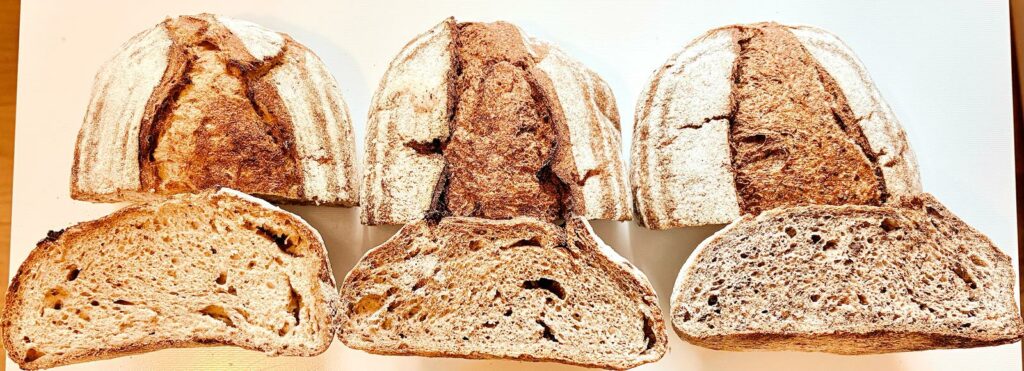
Upcycled and bioactive-enriched sourdough breads from organic short supply chains.
Stage 1 · The seeds
Three seeds, three plant families
The formulation is built on three botanical seeds and what they give us: a cereal, an oilseed and a nut.
Cereal
Wheat
Organic wholewheat, grown locally. The base of every loaf.
Oilseed
Flaxseed
Linum usitatissimum. Milled into flour and added for ω‑3, fibre and lignans.
Nut
Hazelnut
Corylus avellana L. We use the skins that come off during roasting, a by-product that usually goes to waste.
Stage 2 · The field
Grown organic, at Km 0
The wheat is cultivated organically at Azienda Agricola Monchini and goes into the flour without travelling long distances. A short supply chain keeps transport emissions to a minimum and supports farming practices that protect the soil.
Km 0
Local wheat, short supply chain
Organic
Soil-friendly cultivation
Wholewheat
The whole grain is milled
Stage 3 · The starter
A living sourdough mother
From this organic wholewheat flour we developed an artisan sourdough starter. Sourdough wholewheat bread is a cornerstone of the Mediterranean diet and a benchmark for healthy cereal-based products.
This organic wholewheat sourdough is the baseline. We then developed it step by step into three formulations.
Stage 4 · The breads
Three loaves, one step at a time
Each loaf builds on the one before it. The darker crumb shows what each ingredient adds.
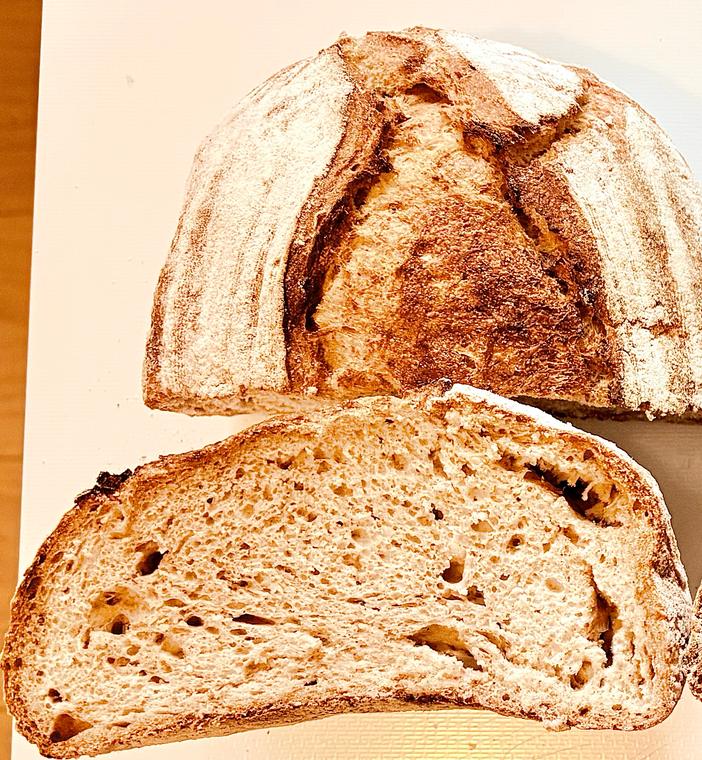
Formulation 1 · Baseline
Organic Km 0 Sourdough Wholewheat Bread
Ingredients: Organic wholewheat flour · Sourdough starter
A traditional sourdough bread made only with locally grown, organic wholewheat flour.
- Minimal transport emissions (Km 0)
- Soil-friendly farming practices
Formulation 2 · Oilseed-enriched
Oilseed-Enriched Functional Bread
Ingredients: Organic wholewheat flour · Flaxseed flour
The same organic wholewheat sourdough, fortified with flaxseed flour (Linum usitatissimum). Flaxseed adds these nutrients naturally:
- α‑linolenic acid, an essential ω‑3 fatty acid
- Soluble and insoluble dietary fibre
- Plant proteins and lignans
- B-group vitamins and essential minerals
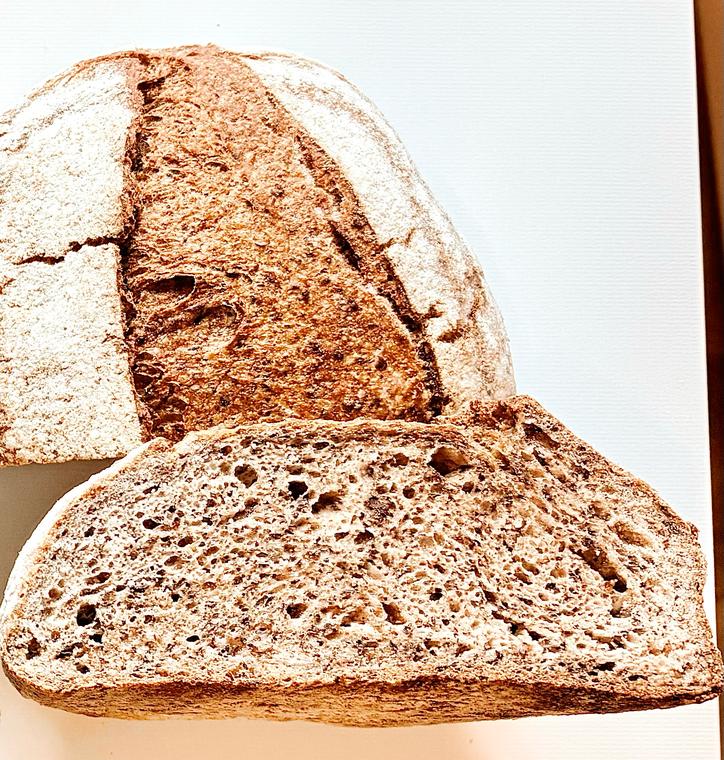
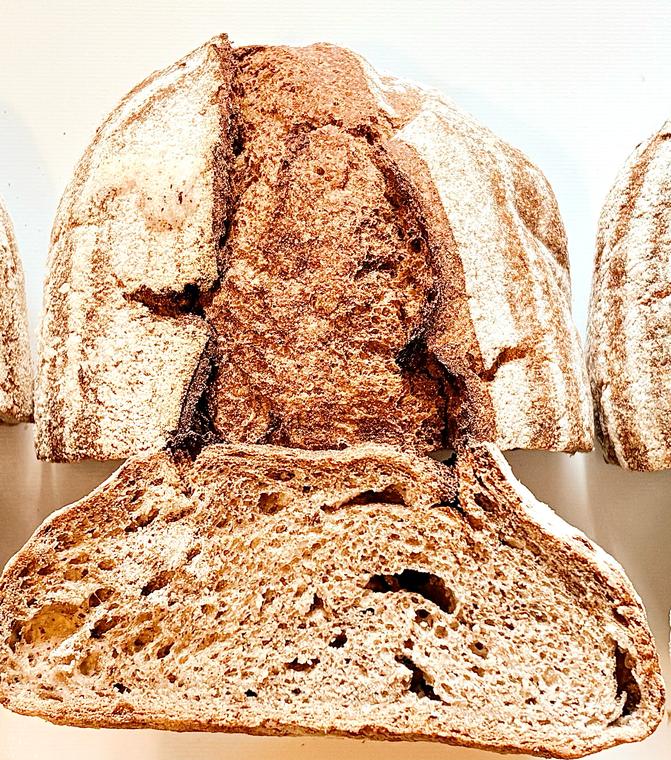
Formulation 3 · Circular economy
Upcycled Bioactive Bread
Ingredients: Organic wholewheat flour · Flaxseed flour · Upcycled hazelnut skins
Co-fortified with flaxseed flour and hazelnut skins (Corylus avellana L.) recovered after roasting organic Roman Hazelnuts PDO. These skins are an agro-industrial side-stream.
- Dietary fibre
- Bioactive polyphenols: condensed tannins and antioxidants
- A by-product recovered as a high-value ingredient
| Ingredient | Bread 1 | Bread 2 | Bread 3 |
|---|---|---|---|
| Organic Km 0 wholewheat | ✓ | ✓ | ✓ |
| Flaxseed flour | – | ✓ | ✓ |
| Upcycled hazelnut skins | – | – | ✓ |
Stage 5 · Closing the loop
Turning a by-product into food
Orchard → Roasting → Skins recovered → Into bread. Zero waste.
Roasting hazelnuts leaves behind their thin skins, called pellicles. They are usually treated as agricultural waste, yet they are very rich in fibre and bioactive polyphenols.
We recover the skins from organic Roman Hazelnuts PDO and put them back into the bread. A potential loss becomes a high-value functional ingredient.
Source of the skins
Azienda Agricola Sciardiglia “La Fescennina”, producer of organic Roman Hazelnuts PDO.
Stage 6 · To the table
Coming soon to market
The zero-waste sourdough bread enriched with upcycled hazelnut skins will soon be sold by Azienda Agricola Monchini.
Local biodiversity
Wheat, flaxseed and hazelnut in one loaf
Organic seed valorisation
More value from every crop
Circular bioeconomy
By-products back into food
The supply chain
Who grows it
Organic wheat · Future seller
Azienda Agricola Monchini
Km 0 organic wheat for the flour, and soon the bread itself.
Hazelnut skins
Azienda Agricola Sciardiglia “La Fescennina”
Organic Roman Hazelnuts PDO. Skins recovered after roasting.
Research partners
In collaboration with
CREA
University of Tuscia
Delekta Srl
From Seeds to Sustainable Foods: Upcycled and Bioactive-Enriched Sourdough Breads from Organic Short Supply Chains.
Presented in line with the FAO paradigm “From Seed to Sustainable Food”.
